Time Zone Calculator
This Time Zone Calculator converts between different time zones. To determine time zones for various locations, use this page as a reference.
What is Time Zone
A time zone is a geographic region where the same standard time is used. These zones are usually defined by country borders or lines of longitude. Greenwich Mean Time (GMT) refers to the mean solar time at the Royal Observatory in Greenwich, London, which lies at zero degrees longitude. While GMT and Coordinated Universal Time (UTC) generally represent the same time, they are not identical—GMT is considered a time zone, whereas UTC is a precise time standard used globally as the reference for civil time. Although GMT was once used as the primary time standard, it is now mainly applied as the time zone in some countries in Western Europe and Africa. UTC, on the other hand, is based on highly accurate atomic clocks along with the Earth's rotation, making it the modern standard. UTC does not change for daylight saving time (DST). However, some countries adjust their local time seasonally. For example, the United Kingdom switches to British Summer Time during the warmer months. Time zones on land are typically expressed as offsets from UTC. Time is measured in days, hours, minutes, and seconds, usually according to the Gregorian calendar. Most time zones differ from UTC by whole hours, such as UTC-05:00 or UTC+08:00. In some regions, though, the offset may include half-hour or even quarter-hour differences, like UTC+06:30 or UTC+12:45.
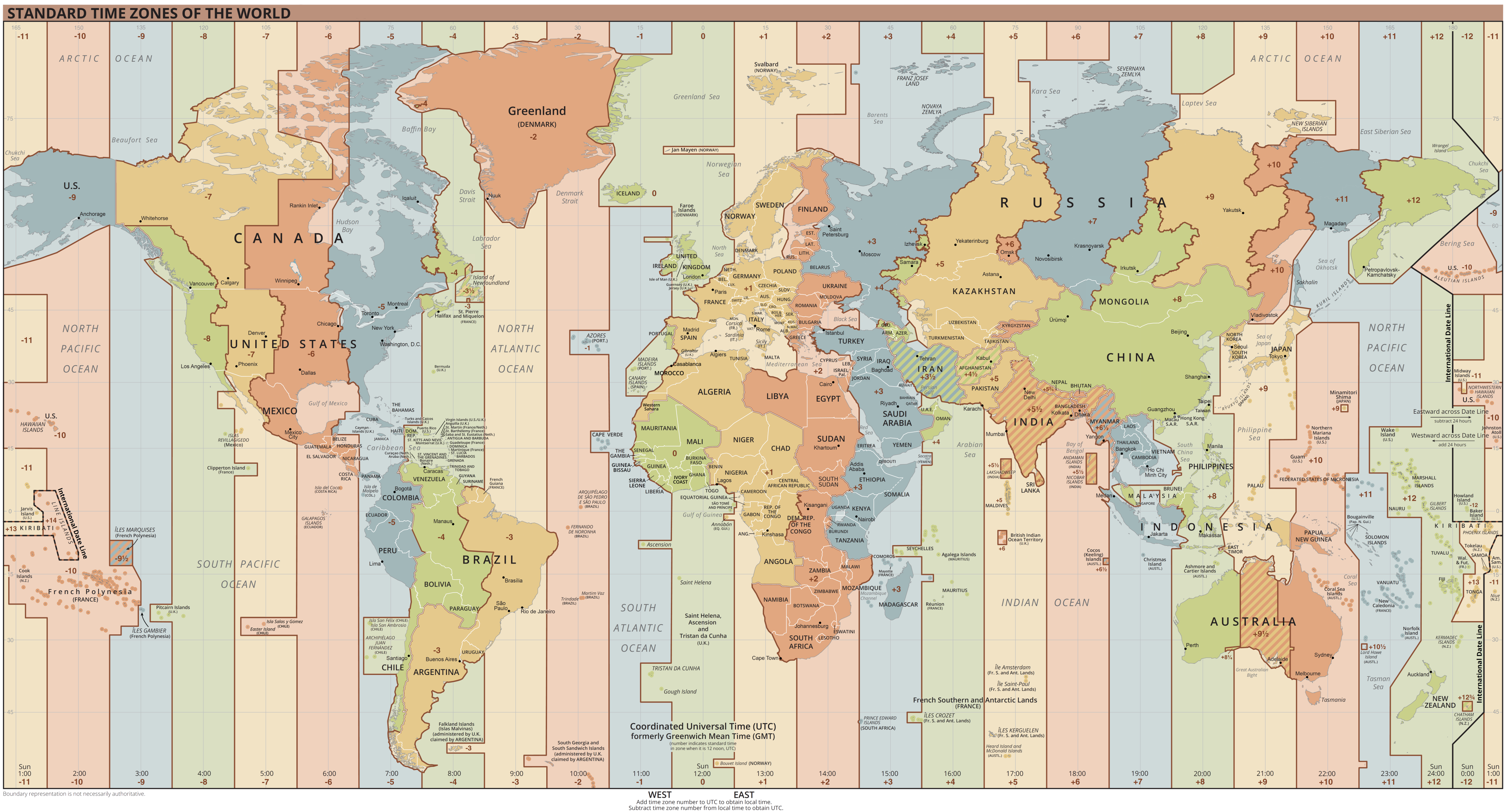
World Time Zone Map
Time zones around the world differ widely, and historically, the differences were even greater. It wasn’t until 1929 that most countries began adopting standard hourly time zones. Nepal was the last country to do so in 1956, and it still uses an uncommon offset of UTC+5:45. In general, every 15° of longitude corresponds to a one-hour time difference. However, this rule is not always followed. For instance, countries like China and India each use a single time zone despite spanning areas much wider than 15° of longitude. On the other hand, Russia is divided into multiple time zones—currently 11—although this number was once reduced to 9. These examples show that while there are general guidelines for determining time zones, actual usage depends heavily on national decisions and can change over time. The map below illustrates the standard time zones across the globe. Click on it to view a larger version.d.